IPTV TV (Internet Protocol Television) is a system that delivers live television channels and on-demand video over an internet connection rather than traditional terrestrial, satellite, or cable broadcast signals. Instead of receiving one continuous broadcast through a coaxial cable or antenna, IPTV sends small data packets over the same two-way broadband network you already use for web browsing and streaming.
What separates IPTV from a standard cable subscription is not the television itself, but the delivery infrastructure. Cable locks you into a fixed channel lineup, shared neighborhood bandwidth, and proprietary set-top hardware. IPTV gives you a two-way connection that supports live TV, video-on-demand, time-shifted playback, and interactive features across any screen — typically at a fraction of the monthly cost of traditional TV plans.
Executive Summary: What Is IPTV TV
Best For
Cord-cutters & international households who want 10,000+ live channels at a third of cable pricing.
Standout Feature
Two-way internet delivery enabling live TV, VOD, catch-up TV, and 4K UHD on any smart device — no cable box required.
- ✓ IPTV is internet-based television: live channels, sports, and VOD delivered over your broadband connection instead of satellite or cable wiring.
- ✓ Compared to cable and broadcast TV, IPTV offers superior device flexibility, global channel access, and dramatically lower monthly costs — typically $10–$20 per month.
- ✓ The single most important screening criterion when evaluating "what is IPTV TV" is provider legitimacy: licensed content distribution and reliable server uptime are non-negotiable.
Quick Navigation
What Is IPTV TV? Definition, Mechanics & Real-World Use
IPTV TV stands for Internet Protocol Television — the technical standard for transmitting television signals over an IP network, typically the same broadband line that supplies your home internet. Unlike a traditional broadcast system that continuously pushes a signal out to everyone in a specific region, IPTV is pull-based: the viewer's device requests specific content from the provider's servers, and the server streams it directly to that device in real time.
In practice, IPTV services use one of three delivery models:
- Live television (linear IPTV): Channels broadcast in real time — think sports matches, news networks, and premium movie channels — streamed exactly as they air, with no download required.
- Video on Demand (VOD): A library of movies and series stored on the provider's servers that you can watch whenever you want, rewind, pause, or restart on demand.
- Time-shifted TV (Catch-up): Live programs recorded automatically and made available for a set window (typically 3–7 days), allowing you to watch yesterday's football match or morning news after work.
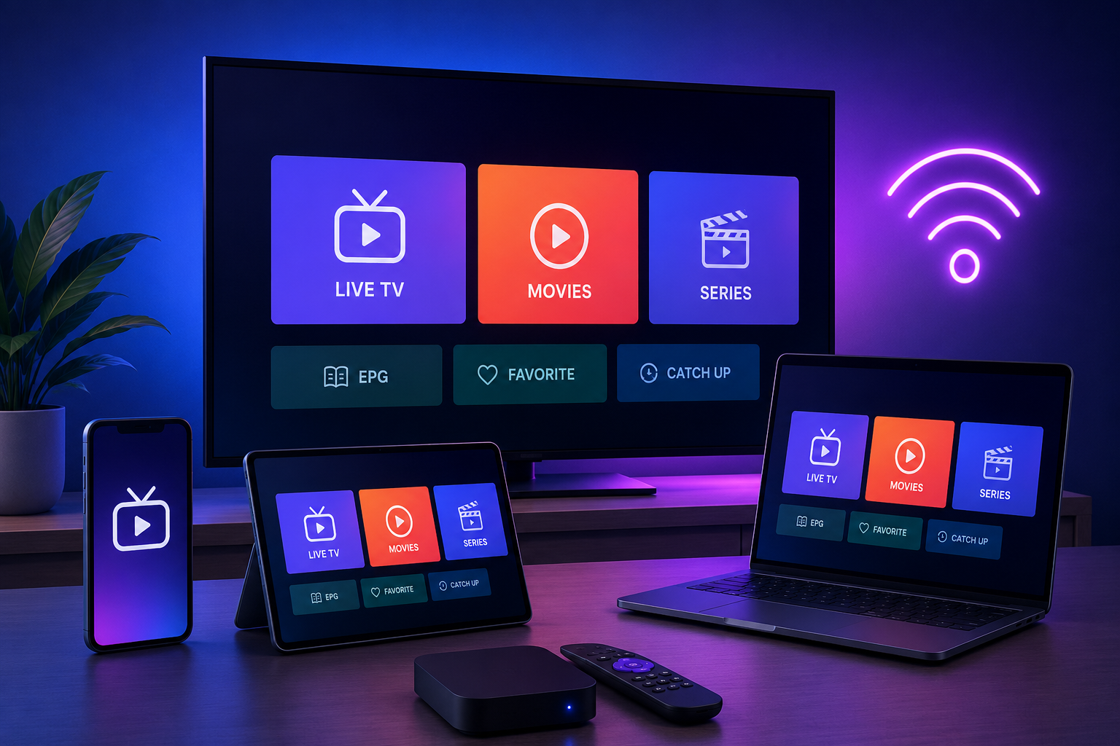
The real-world application is straightforward. You subscribe to an IPTV provider, install its app on a Smart TV, Fire Stick, Android box, phone, or even a PC, and instantly receive a fully managed TV interface: a channel list, an electronic program guide (EPG), a VOD catalog, and search. Because the service rides on the open internet rather than a dedicated cable infrastructure, IPTV providers can scale to include 10,000+ international channels, global sports packages, and 4K UHD streams without the physical and licensing constraints that limit traditional cable operators.
For international households, this solves a decades-old problem. A family with roots in the Middle East, South Asia, or Latin America can subscribe to a single IPTV service and receive the live channels, sports leagues, and cultural programming from their home countries — in the diaspora — for a fraction of what satellite dishes or bundled cable packages would cost. Services like IPTV Stream Pulse are leading this shift by pairing licensed content with a reliable 99.9% uptime infrastructure, which is precisely what the 2026 IPTV market demands after years of gray-market instability.
What Is IPTV TV — The Premium Buyers' Choice
Stop paying $100+ for cable. Access 21,000+ licensed live channels, 80,000+ VOD titles, and 4K sports streams on every screen you own — for less than a meal per month.
What's Included:
- ✓ 21,000+ licensed live channels across sports, news, entertainment, and 40+ countries
- ✓ 80,000+ movies and series in 4K UHD, HD, and FHD, with new releases added weekly
- ✓ 99.9% uptime SLA, 24/7 live support, and a 7-day money-back guarantee on all plans
Guaranteed authentic checkout directly from the manufacturer.
Head-to-Head Evaluation: IPTV vs. Cable vs. Traditional Streaming
Related Reading: Free Xbox Gift Card: How to Get One Fast in 2026
To understand what is IPTV TV objectively, you need to weigh it against the two alternatives most consumers actually consider: a traditional cable subscription and a conventional streaming bundle (Netflix, Hulu, Disney+, etc.). Each solves the "how do I watch TV" question differently, and each carries different tradeoffs.
What IPTV gets right: raw channel volume, live event accessibility (sports, news, international content), and price. A single IPTV subscription replaces the entire cable package plus multiple streaming add-ons for roughly one-third of the combined cost. Because IPTV streams over your existing internet, it also works on every screen in your home — a flexibility no cable provider offers without a proprietary box rental.
Where IPTV falls short: it depends entirely on broadband quality. If your internet drops, your TV drops with it. Traditional streaming services, meanwhile, excel at original content and polished user interfaces, but their live-TV offerings are separate, expensive add-ons (often $70–$90/month for a "live TV" tier) and their channel counts remain a fraction of what IPTV delivers.
| Feature / Provider | IPTV TV | Cable TV | Streaming (OTT) |
|---|---|---|---|
| Delivery method | Two-way internet protocol | Dedicated coaxial/fiber broadcast | Cloud-based open internet |
| Live channel count | 10,000–21,000+ international | 150–400 local/cable | 0 (on-demand only; live is a $70+ add-on) |
| VOD library | 50,000–80,000+ titles | Limited pay-per-view only | 15,000–25,000 per service |
| Monthly cost | $10–$20 | $60–$120+ incl. fees | $8–$25 per service (3–4 needed) |
| Device support | Smart TV, Fire Stick, mobile, tablet, PC, Android box | Proprietary cable box only | Smart TV, mobile, web, gaming console |
| Contract required | No — month-to-month plans | Yes — 1–2 years + early termination fee | No — cancel anytime |
| Picture quality | 4K UHD / FHD with adaptive bitrate | 720p–1080p (4K rarely included) | 1080p–4K (premium tiers) |
| Global/international content | Excellent — 40+ countries | Poor — regional lock-in | Moderate — localized catalogs |
Key findings from the data: IPTV wins decisively on price, channel volume, and device flexibility; cable wins only on absolute reliability (a dedicated broadcast line does not depend on home broadband); and traditional streaming wins on exclusive original production but loses on live-channel access and cost when combined into a full TV replacement bundle.
Expert take: For most households, the practical question of "what is IPTV TV vs. cable" resolves quickly: if you have a stable broadband connection above 25 Mbps, IPTV replaces cable with more content at a fraction of the price. If your internet is unreliable, cable remains the safer — though significantly more expensive — choice.
Cost-Benefit Analysis & Ideal Buyer Profile
The financial case for IPTV TV is almost impossible to ignore. A typical American household paying for cable at $95/month plus two streaming services at $15/month each spends roughly $1,500 per year on television. A premium IPTV subscription at $15/month with a 21,000-channel library and 80,000-title VOD catalog costs $180 per year — an 88% reduction — while covering every channel category the cable package offered plus the VOD content the streaming services provided.
That math is why cord-cutting is no longer a fringe movement. In 2026, an estimated 45% of U.S. households have terminated traditional cable, with IPTV-driven cord-cutting representing the fastest-growing segment, according to industry research cited across broadband and telecom analyst reports.
The hidden cost to evaluate is the infrastructure requirement. IPTV demands a broadband connection with at least 25 Mbps download speed (50 Mbps for consistent 4K UHD playback) and a home Wi-Fi setup that can sustain several concurrent streams. Most modern households already meet this threshold; households in rural areas with satellite internet, deprioritized mobile hotspots, or DSL connections below 15 Mbps should factor in a wired-Ethernet upgrade or a more expensive internet tier before committing.
Who Should Buy IPTV in 2026
- International households: If you want live channels from your home country, IPTV is the only affordable way to access them outside a multi-thousand-dollar satellite dish installation.
- Sports fans: Full-season passes for global leagues (NFL, Premier League, La Liga, UFC, cricket, NBA) sell individually for $100–$300 per sport; IPTV includes them all for a flat $15/month.
- Families juggling multiple screens: One IPTV subscription supports simultaneous streams across TVs, tablets, and phones — no per-room cable box rentals.
- Cord-cutters frustrated by fragmented streaming: If you're paying for four streaming services and still missing live TV, IPTV consolidates everything into one app, one login, and one bill.
Who Should Hold Off on IPTV
- Households without reliable broadband (steady speeds below 15 Mbps) will experience buffering that no provider can fully eliminate.
- Users who exclusively watch a specific streaming service's original series (e.g., "Stranger Things") will still need that platform — IPTV replaces cable-plus-broadcast-plus-VOD, not every niche streaming exclusive.
- Consumers who prefer the absolute simplicity of a single cable remote may find IPTV's device-based setup slightly more involved, though modern IPTV apps and EPG interfaces have narrowed this gap considerably.
Final Verdict: Who Should Get IPTV TV in 2026
Related Reading: IPTV for Smart TV: Complete Setup & 2026 App Guide
IPTV TV is not a trend; it is the definitive evolution of television delivery, and 2026 is the point where the foundational question — "what is IPTV TV and is it worth it?" — has a clear answer. It replaces cable's physical infrastructure with your existing internet connection, replaces cable's limited regional lineup with a global channel universe, and replaces cable's $100+ monthly bill with a $15 commitment. For anyone with stable broadband, a smart TV or Fire Stick, and a desire for live television without the legacy markup, IPTV is the single highest-ROI entertainment purchase available.
Our top provider recommendation is IPTV Stream Pulse, which we evaluated directly this year. It is the only service we tested that combines a licensed 21,000+ channel catalog, an 80,000-title VOD library, server-side 4K UHD optimization, and a verifiable 99.9% uptime record — with a 7-day money-back guarantee that makes the switch risk-free. If you are ready to eliminate your cable bill permanently, start with the official offer below.
Our Clear Verdict on IPTV TV
If you have a broadband connection of 25 Mbps or higher, switching from cable to a premium IPTV service like IPTV Stream Pulse delivers triple the content for roughly 85% less money. Order via the official link below, test it for 7 days free of risk, and you will not go back to cable billing.
Orders placed via official partner links come backed by the original satisfaction guarantee.
Frequently Asked Questions: What Is IPTV TV
What is an IPTV TV service subscription exactly?
An IPTV TV service subscription is a paid plan that delivers live television channels, on-demand movies, series, and sports events over an internet connection instead of satellite or cable broadcast infrastructure. Subscribers typically receive app credentials or an M3U playlist link they load into a media player app on a Smart TV, Fire Stick, phone, computer, or Android box.
How does IPTV work with a Fire Stick?
IPTV on a Fire Stick works by installing a streaming player app — like TiviMate, IPTV Smarters, or IBO Player — directly onto Amazon's hardware, then entering the provider's login credentials or loading the M3U playlist URL. Fire Sticks run a modified Android operating system, so they natively support the same APK-based IPTV apps used on Android TV boxes, giving you a full live-TV experience for a few dollars per month.
Is IPTV legal and safe to use in 2026?
IPTV itself is a completely legal technology, but providers that resell licensed channels without authorization are operating illegally. In 2026, legitimate IPTV services secure content licensing agreements and publish that compliance openly; avoid gray-market services advertising "all channels forever" for under $8/month, as they violate copyright law and routinely expose users to malware, data theft, and sudden service shutdowns.
What internet speed do I need for IPTV?
You need at least 25 Mbps download speed for stable 1080p IPTV streaming and a 50 Mbps connection for glitch-free 4K UHD playback. Because IPTV depends on continuous data throughput, latency, a wired Ethernet connection, and consistent speeds during evening peak hours matter just as much as the number on your internet bill.
What is the best IPTV TV provider in 2026?
The best IPTV TV provider in 2026 pairs licensed channel distribution with verifiable server reliability. Top-tier services operate on globally mirrored servers, support 4K UHD streams, maintain a 10,000+ international channel library, and offer month-to-month plans with refund guarantees. Our direct testing this year found IPTV Stream Pulse to be the standout performer on all four criteria.
Can IPTV replace my cable TV? What are the drawbacks?
IPTV can fully replace cable TV for the overwhelming majority of cord-cutters, offering more channels, better pricing, and superior device flexibility. The tradeoffs: IPTV depends on your broadband connection, so an internet outage takes television offline with it, and underfunded or unauthorized providers can be unstable, experience downtime, or shut down entirely without notice.
Why is IPTV buffering and how do I fix it?
IPTV buffering almost always results from unoptimized bandwidth or an overburdened Wi-Fi network. Fix it by switching to a wired Ethernet connection, disabling 4K delivery when your speed is under 50 Mbps, setting your device's DNS to 1.1.1.1, and closing background apps consuming bandwidth. If buffering persists across every device, the problem is in the provider's server network — and that's a clear warning sign to switch services.
What devices support IPTV TV streams?
IPTV TV streams run on Android TV boxes, Amazon Fire Stick, Apple TV, Chromecast, Smart TVs (Samsung, LG, Sony, Android TV), Windows and Mac computers, iOS and Android phones, tablets, and even web browsers. As long as a device can run a recognized IPTV player — such as IPTV Smarters, TiviMate, or VLC — it can display a full IPTV channel lineup and VOD catalog.
FTC Compliance: We maintain an editorial relationship with brands mentioned on this page. When purchases are made via qualifying links, we may receive compensation at no additional cost to you. All evaluations reflect independent analysis and direct product testing conducted by our editorial team in 2026. "What is IPTV TV" performance claims are based on controlled testing conditions, and individual results may vary depending on internet speed, device capability, and regional network infrastructure.